
Advancing Thermal Control | Falcontech at the 6th Thermal Management Industry Conference
From December 3 to 5, the 6th Thermal Management Industry Conference and Expo (iTherM2025) was grandly held in Shenzhen. This conference is positioned as a one-stop, high-efficiency value service platform for the thermal management industry chain, closely focusing on strategic emerging industry clusters such as electronic information, new energy, semiconductors, automobiles, and low-altitude economy. It brings together more than 350 industry leaders and more than 2,000 professional visitors, focusing on policy, materials, technology, and engineering applications in the field of thermal management...
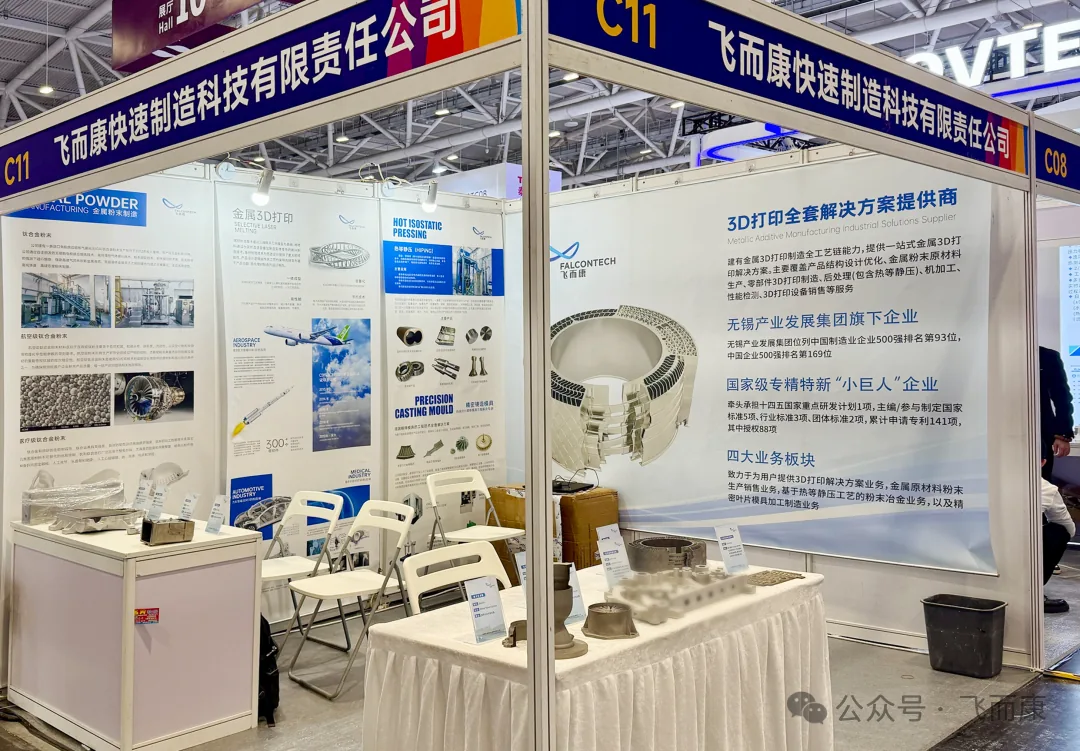
From December 3-5, the 6th Thermal Management Industry Conference and Expo (iTherM2025) was grandly held in Shenzhen. This conference is positioned as a one-stop, high-efficiency value service platform for the thermal management industry chain, closely focusing on strategic emerging industry clusters such as electronic information, new energy, semiconductors, automobiles, and low-altitude economy. It brings together more than 350 industry leaders and more than 2,000 professional visitors, focusing on cutting-edge trends and development opportunities in the field of thermal management in terms of policy, materials, technology, and engineering applications, and jointly promoting the innovative integration of thermal management technology and in-depth breakthroughs in industrial practice.
At this high-profile industry event, Falcontech presented a series of innovative metal 3D printing application cases that address efficient heat dissipation challenges, providing breakthrough "smart" manufacturing solutions to deal with thermal management problems caused by miniaturization and high performance of new energy vehicles, industrial equipment, chips, devices and electronic equipment.
With the rapid development of industries such as 5G communications, new energy vehicles, aerospace, and high-end electronic equipment, heat dissipation efficiency has become a key bottleneck that determines product performance and reliability. Traditional manufacturing processes face many limitations in dealing with complex flow channels, thin-walled structures, topology optimization and material integration. With its high degree of customization potential, 3D printing technology can effectively break through the limitations of traditional processes and create optimal performance solutions tailored for various specific application scenarios.
On the one hand, 3D printing technology solves the leakage risks caused by traditional multi-part assembly from the source through integrated molding structures, significantly improving the reliability and lifespan of components under high-pressure conditions. On the other hand, 3D printing technology allows unprecedented design freedom, allowing the direct manufacture of optimized structures containing complex flow channels, special-shaped fins and walls as thin as 200 microns. It not only achieves extremely high power density and heat dissipation efficiency, but also significantly saves materials.
With years of focus on the field of metal additives, Falcontech has built core advantages covering the entire cycle of thermal management products. Starting from the front-end materials science, machine learning drives alloy composition design to achieve precise customization of material properties. At the same time, the company has a 400-1500mm format printing equipment group and a complete post-processing and inspection system to effectively ensure the high-quality batch delivery of medium and large complex parts.
It is worth mentioning that Falcontech can provide full-chain component-level solutions from product development-oriented design optimization and additive manufacturing to precision machining, surface treatment and testing and certification. With rapid response and consistently reliable technical capabilities, it provides customers with truly end-to-end one-stop additive manufacturing value.
In the future, Falcontech will continue to delve into the integration and innovation of additive manufacturing technology and thermal management needs, actively collaborate with the upstream and downstream of the industry chain, and strive to bring more efficient, more reliable, and more sustainable cooling products and system solutions to the market, and empower the breakthrough and development of strategic emerging industries such as electronic information, new energy vehicles, and low-altitude economy. We look forward to working with partners from all walks of life to jointly define the future of thermal management.